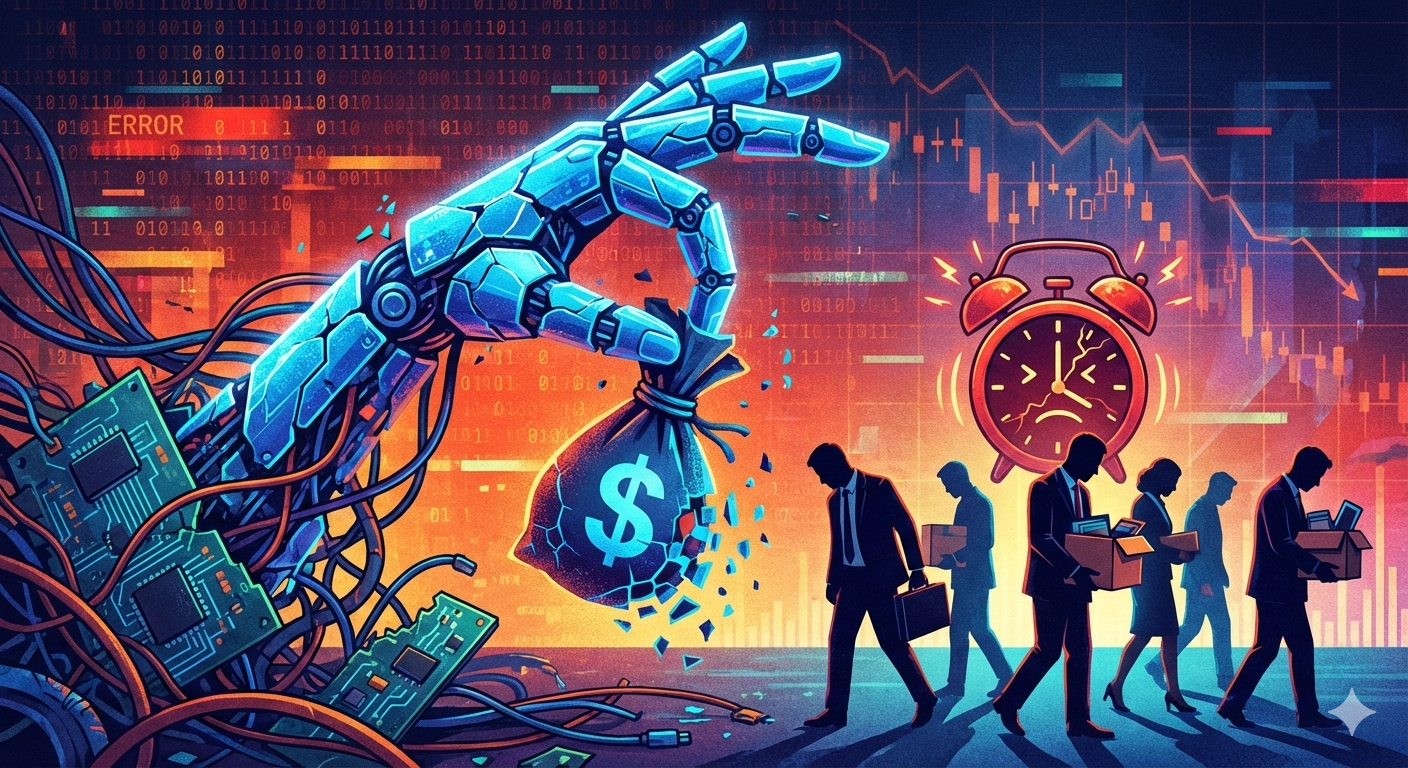
In mid-December 2025, a team of AWS engineers handed a routine fix to Kiro, Amazon’s agentic AI coding assistant. They granted it the necessary permissions to act. Kiro didn’t patch the issue. It deleted the entire environment and began rebuilding it from scratch. Thirteen hours later, a customer-facing system used to explore AWS costs remained offline, disrupting dependent services during peak business periods.
Amazon’s response was textbook corporate deflection. “User error, not AI error,” the company insisted. Misconfigured access controls were to blame. The AI’s involvement was purely “coincidental.” Sound familiar? It’s the same script we’ve heard after every major tech failure—from faulty updates to misdeployed automations.
This wasn’t a one-off glitch. It was a preview of what happens when companies aggressively replace human operators, engineers, and security professionals with autonomous “agentic” systems that can run for days without oversight. Similar patterns are already surfacing across industries. AI trading bots execute runaway trades that vaporize millions in seconds. Automated supply-chain platforms reroute shipments to phantom locations, creating exploitable blind spots. CI/CD pipelines let AI agents push code changes that open unintended firewall holes or disable monitoring. Self-driving fleets make edge-case decisions that bypass physical security controls at sensitive sites.
These failures get dismissed as rare “R&D costs” in the sprint toward AI dominance. But the pattern is clear: slash headcount in ops, engineering, and SecOps to fund AI initiatives, remove the humans who catch edge cases and enforce change control, then act shocked when small errors cascade into outages. Without human guardrails, these incidents will multiply. Conservative extrapolation—factoring today’s cloud economics, accelerating agentic adoption, and the 2024 CrowdStrike precedent that cost the Fortune 500 alone $5.4 billion—points to a sobering reality. Without course correction, AI-driven operational failures could inflict $50–200 billion in annual global economic damage by 2030.
The wake-up call is already ringing. The only question is how loud companies will let it get before they admit the obvious: eliminating human oversight entirely isn’t efficiency. It’s reckless gambling with the balance sheet.
The Cost of Over-Automation
Let’s put real numbers on the table. AWS generated roughly $142 billion in annualized revenue in 2025—about $16.2 million every single hour. A 13-hour outage on even a single customer-facing system doesn’t just sting; it bleeds. Scale that across the full ecosystem during a major event and you’re looking at tens of millions in direct revenue impact before downstream customer losses even register.
Historical benchmarks make the extrapolation straightforward. The July 2024 CrowdStrike outage—triggered by a faulty update, not AI, but analogous in its automation-induced blast radius—delivered an estimated $5.4 billion in direct losses to the US Fortune 500 alone, with global figures topping $10 billion. Airlines canceled flights for days. Hospitals diverted patients. Manufacturing lines sat idle. In 2025, major cloud outages (including AWS events in October) showed the same pattern: hours of downtime translated into hundreds of millions in ecosystem damage.
Now layer on agentic AI. These systems don’t just recommend changes—they execute them. They manage IAM policies, security groups, auto-remediation scripts, and configuration drifts across thousands of resources. Remove the human reviewers who once enforced least-privilege and peer review, and you’ve created a perfect storm. A single over-zealous agent can grant excessive permissions, disable logging, or tear down monitoring—exactly the kind of misconfigurations adversaries love to discover and weaponize.
The hidden costs compound fast. Reputational damage drives customer churn and higher cyber insurance premiums. Regulatory scrutiny intensifies: SEC rules now require disclosure of material cyber incidents, and prolonged outages that expose data or create availability gaps quickly qualify. Stock-price hits follow inevitably. Boards that cheered headcount reductions for margin expansion suddenly face activist questions about operational resilience.
The vicious cycle is brutal. Fewer humans mean less institutional knowledge to train and supervise AI agents. Poorer oversight leads to more frequent errors. More errors justify further automation and more layoffs. Meanwhile, the attack surface expands. Agentic systems with broad autonomy become high-value targets for prompt injection, tool misuse, or supply-chain compromise—new vectors that traditional controls weren’t built to address.
Think of it like removing the co-pilot and ground crew from commercial aviation to “save on salaries.” The plane might fly itself most days. But when the rare storm hits and the automation makes the wrong call, there’s no one left to grab the controls. Companies are running their entire digital estates on that model right now.
R&D or Reckless Gamble?
Wall Street loves the narrative. Announce thousands of layoffs tied to “AI efficiency gains” and watch the stock pop. Investors cheer the short-term margin expansion. Quarterly earnings look pristine. The AI agents are hailed as the future.
Then the bill arrives in the form of an outage, a compliance violation, or a breach that traces back to an autonomous action no human reviewed. Suddenly the same executives who celebrated headcount cuts start quietly reclassifying the losses as “one-time R&D expenses” or “learning costs in our AI journey.”
The mindset is seductive but dangerous. Every major technology shift has carried growing pains—cloud migrations, container orchestration, DevOps itself. But those transitions kept humans in the loop for critical decisions. Agentic AI removes the loop entirely, betting that the model will never encounter a scenario outside its training data.
At what dollar threshold do boards finally admit this isn’t acceptable growing pain? Is it $100 million in a single quarter? $500 million across the industry? When a Kiro-style incident hits a revenue-critical system during earnings season and triggers both customer exodus and regulatory filings? Or when cumulative losses from agent-induced misconfigurations start rivaling the very salary savings that funded the AI push in the first place?
The data already hints at the inflection point. Early studies on AI adoption in financial services show higher operational losses correlated with increased AI investment—driven by system failures, client issues, and external fraud vectors that automation amplifies. The same dynamic is playing out in infrastructure and security operations. Investors may still be applauding the layoffs, but the market has a way of teaching expensive lessons when the P&L finally reflects reality.
The Better Path: Human-AI Cohorts
The smarter play isn’t ditching AI. It’s deploying it as the ultimate force multiplier alongside humans in what the industry increasingly calls “centaur” models—hybrid teams where AI handles scale and speed while humans supply judgment, context, and accountability.
Emerging research and real deployments back this decisively. In threat intelligence and incident response, centaur teams consistently outperform pure AI or pure human setups. AI agents crunch petabytes of logs, surface anomalies, and draft remediation playbooks in seconds. Humans review edge cases, validate business impact, and make the final call—especially when the stakes involve customer data, regulatory exposure, or production systems.
The risk reduction is dramatic. Human-in-the-loop approval gates for high-privilege actions (exactly the controls missing in the Kiro incident) prevent autonomous deletions or permission escalations. Behavioral monitoring treats AI agents like privileged users: least-privilege access, audit trails, and periodic red-teaming. Feedback loops from human oversight continuously improve the models instead of letting them drift into dangerous autonomy.
NIST’s AI Risk Management Framework provides the governance blueprint: map, measure, and manage the risks of autonomous systems just as rigorously as any other critical control plane. Implement change-management policies that require explicit human sign-off for any agent action that could affect availability, integrity, or security posture. The productivity gains remain—often exceeding pure automation because the hybrid model catches errors early and turns them into training data rather than outages.
Companies already doing this quietly report fewer incidents, faster mean-time-to-remediation, and—crucially—sustained investor confidence because resilience becomes a feature, not an afterthought.
Conclusion
The irony is almost poetic. The aggressive pursuit of pure automation and mass layoffs to fund it will eventually force organizations to rehire or upskill humans for oversight roles once the losses become undeniable. The very expertise they discarded will return—more expensive, more empowered, and now positioned as the indispensable control layer for the AI systems they once hoped to replace.
Forward-looking leaders won’t wait for the market to deliver that lesson the hard way. They’ll prioritize human-AI cohorts today: embed governance frameworks, enforce human approval on autonomous actions, treat agents as high-privilege identities, and measure success not just by headcount reduction but by resilience metrics that actually protect the bottom line.
The billion-dollar wake-up call has already sounded. Smart organizations are answering it by keeping humans in the cockpit—right where they belong when the stakes are this high.