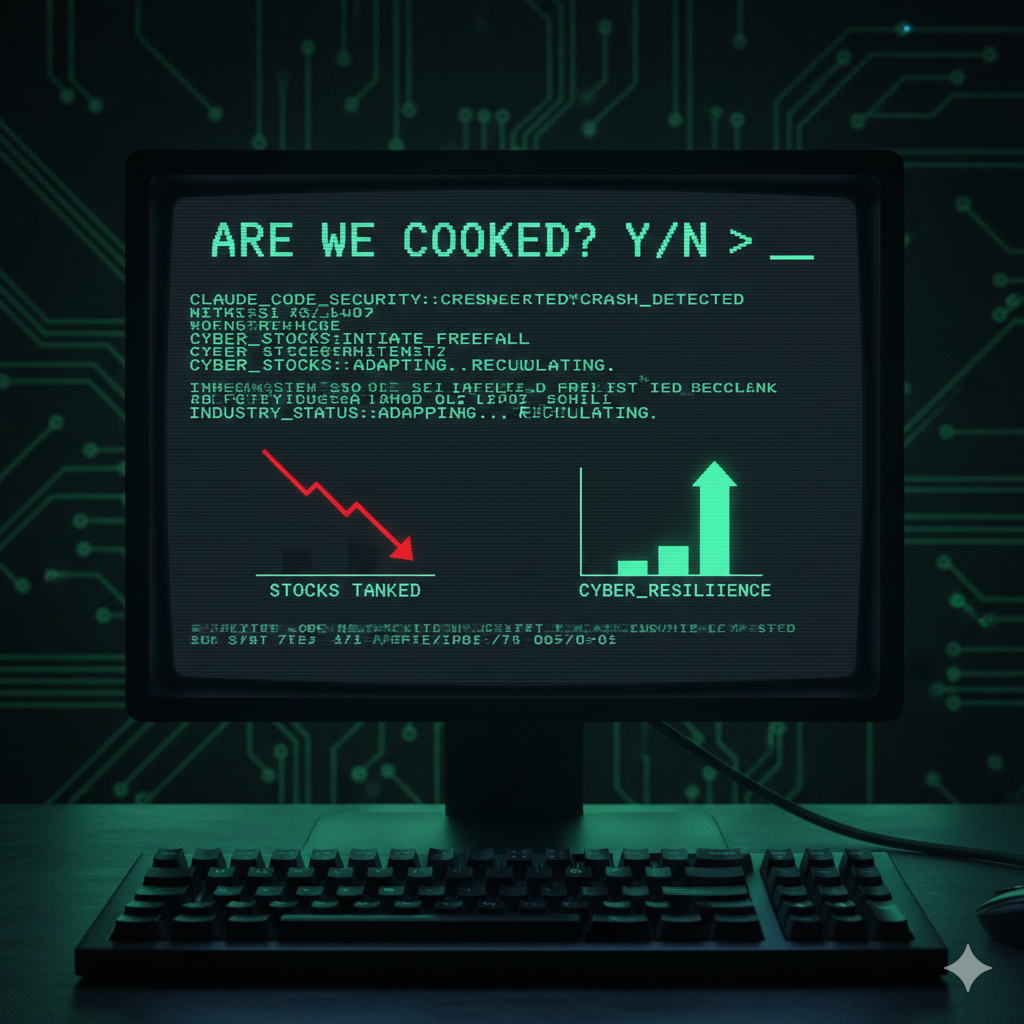
On Friday, February 20, 2026, cybersecurity stocks took a beating. CrowdStrike fell nearly 8%, Okta dropped over 9%, Cloudflare slid 8%, and the Global X Cybersecurity ETF hit its lowest close since November 2023. The trigger? Anthropic’s quiet but seismic announcement of Claude Code Security—a new capability baked directly into Claude Code on the web.
The internet, predictably, lost its mind. Headlines screamed “AI is coming for your SOC,” Reddit threads declared the industry “cooked,” and X timelines filled with doomsayers claiming Palo Alto Networks, CrowdStrike, and every traditional security vendor just got obsoleted overnight.
Let’s cut through the noise. This is not the end of cybersecurity. It’s the latest chapter in the oldest story in tech: a frontier AI lab releasing a powerful new feature to fund its runway to AGI while the market overreacts. We’ve seen this movie before—xAI’s recent restructuring and SpaceX merger, OpenAI’s February ad tests in ChatGPT for free and Go-tier users. Every major player is scrambling for new revenue streams in the global AGI race. Anthropic’s move is no different. They’re selling both the problem and the solution, positioning themselves as the indispensable middle layer between vulnerable code and the defenders who must fix it.
What Claude Code Security Actually Does (and Doesn’t Do)
According to Anthropic’s own release, Claude Code Security is a research-preview tool that scans entire codebases, reasons about them like a senior security researcher, traces data flows, understands component interactions, and surfaces complex vulnerabilities that rule-based static application security testing (SAST) tools routinely miss. It then suggests targeted patches—for human review and approval only. Nothing ships automatically.
In internal testing with Claude Opus 4.6, the system reportedly identified over 500 previously unknown high-severity vulnerabilities in production open-source codebases—bugs that had survived years or decades of expert human review. That’s genuinely impressive. It also includes a multi-stage verification loop to reduce false positives and rates findings by severity and confidence.
But here’s the part the hype machine conveniently ignores: this is still a tool, not an autonomous security agent. It requires human oversight at every critical step. It doesn’t deploy fixes. It doesn’t handle runtime behavior. It doesn’t understand business context, regulatory requirements, or the messy reality of production environments where “fixing” one thing can break three others.
In other words, we’re watching a recursive loop in real time. AI models trained on decades of human-written insecure code are now being marketed as the cure for that same insecure code. The same labs accelerating code generation are now selling the patch for the vulnerabilities their own acceleration creates. It’s elegant marketing, but it doesn’t magically eliminate the need for the humans who created both the problems and the creative solutions.
Why the Cybersecurity Industry Is Not “Cooked”
The murmur online is loud: “Traditional cyber is dead. AI agents will secure everything.” That narrative collapses the moment you examine the hard problems still unsolved.
First, training data dependency. Every large language model today—including Claude—is built on human-generated data. When humans stop producing novel research, writing new exploits, discovering zero-days, or inventing defensive techniques, the models stagnate. They are exceptionally good at pattern matching and interpolation. They are not (yet) good at the genuine creativity and intuition required to defend against truly novel attack surfaces.
Second, the attack surface is expanding faster than any single tool can cover. Cloud-native environments, IoT/OT convergence, AI supply-chain attacks, prompt-injection vectors, model poisoning—the list grows daily. Claude Code Security might catch logic flaws in a monolith, but it doesn’t replace the need for runtime protection, behavioral analytics, identity fabric management, or the human-led threat hunting that turns raw telemetry into actionable intelligence.
Third, regulatory and compliance reality. Auditors, boards, and regulators do not accept “the AI said it was fixed” as evidence of due diligence. They want documented human review, change control, and accountability. Claude Code Security explicitly acknowledges this by keeping humans in the loop. That design choice is telling.
Finally, the economics. Major cybersecurity vendors aren’t standing still. CrowdStrike, Palo Alto, and others are already integrating their own AI capabilities—often with deeper telemetry access and years of proprietary threat intelligence that no frontier lab can match overnight. The winners will be those who treat AI as a force multiplier, not a replacement.
The Road Ahead: Integration, Not Replacement
We don’t need more fear. We need focus.
Security teams that thrive over the next 24–36 months will treat tools like Claude Code Security the way they treated early EDR or cloud security posture management: as powerful new capabilities to layer into existing workflows.
Practical steps you can take today:
- Pilot aggressively but scoped — Apply for the research preview. Feed it a non-production codebase with known historical issues. Measure time-to-remediation, false-positive rate, and—most importantly—how many novel findings your human team would have missed.
- Build human-AI review rituals — Treat every suggested patch like a pull request from a brilliant but junior developer. Require senior engineers to validate the reasoning, not just accept the diff.
- Double down on irreplaceable human skills — Threat modeling, red-team creativity, business-context understanding, cross-team communication, and ethical judgment remain uniquely human. Invest in those capabilities now.
- Demand transparency from AI vendors — Ask Anthropic (and every other player) for confidence scoring, explainability artifacts, and clear boundaries on what the model will never do autonomously in security contexts.
- Prepare for the next wave — The real disruption won’t be one tool finding bugs. It will be when attackers also gain frontier-level code-reasoning capabilities. The defender advantage only lasts as long as we stay ahead on integration and governance.
The Bottom Line
Claude Code Security is a legitimate step forward. It will help teams ship more secure code faster. It will force traditional SAST/DAST vendors to raise their game. And yes, it contributed to a one-day bloodbath in cyber stocks.
But the cybersecurity industry is not cooked. It’s being forced to level up—exactly what healthy, competitive markets do.
The models are getting more capable and more autonomous every quarter. That’s real. The hype that accompanies each release is also real. What isn’t real is the idea that humans suddenly become obsolete in defending the systems we built and will continue to evolve.
We have been writing insecure code for decades. We have also been inventing the defenses that keep civilization running. The robots aren’t replacing that cycle—they’re accelerating it. Our job is to stay in the driver’s seat, apply creativity and intuition where algorithms still fall short, and make the digital spaces humans actually interface with dramatically safer than they were yesterday.
The future of cybersecurity isn’t AI versus humans.
It’s humans, augmented by AI, staying one step ahead of the threats we ourselves create.
That future is still very much ours to build.
Let’s get to work.